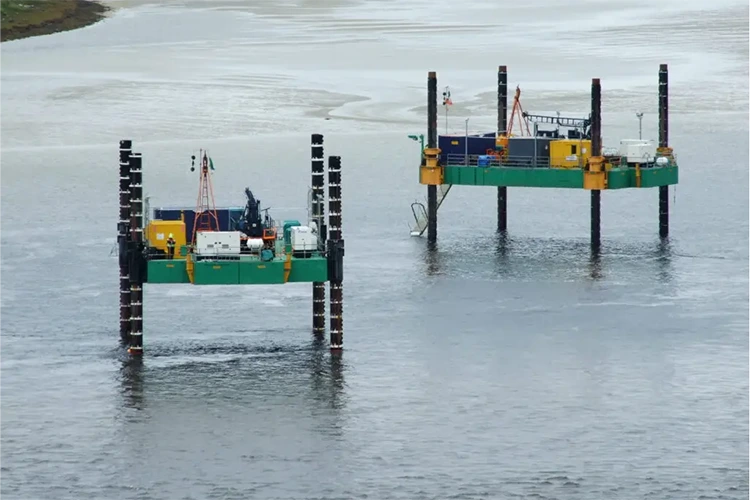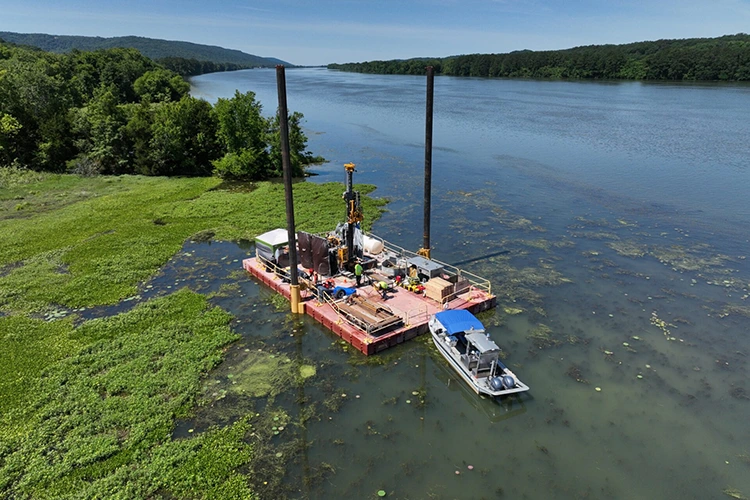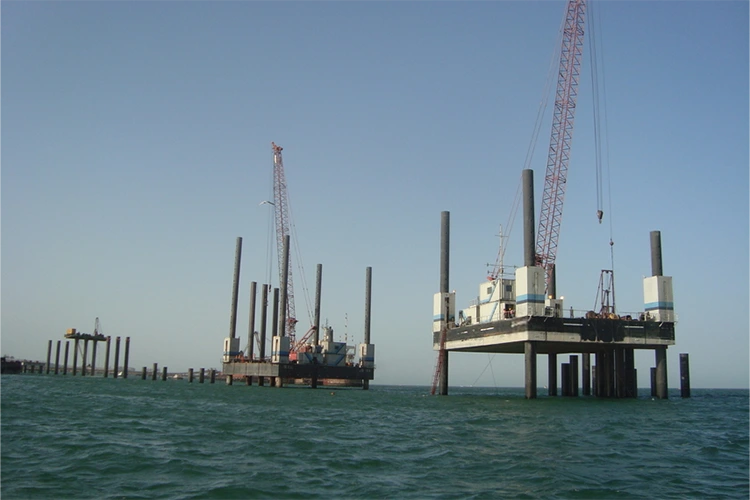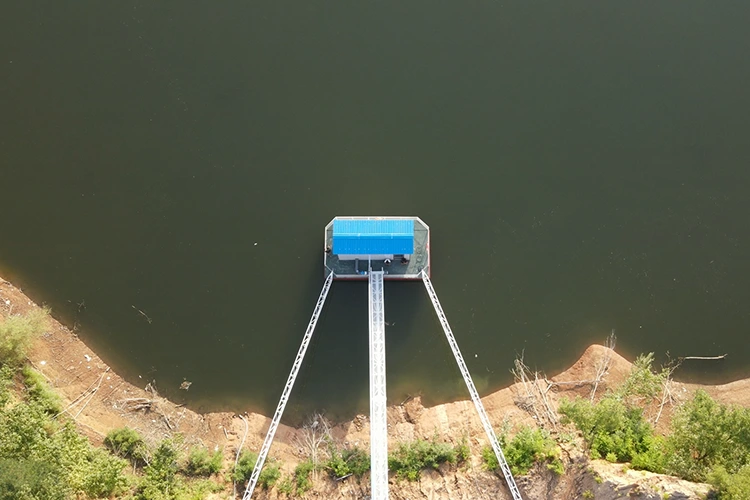

HAIDING SHIPYARD specializes in modular waterborne engineering equipment and develops the Rapidly Emplaced Bridge for flood control, disaster relief, emergency transportation, infrastructure recovery, and marine engineering. With standardized self-propelled pontoon modules, the system can create temporary floating crossings from 10 meters to more than 100 meters, providing a practical solution when conventional transportation routes are damaged or unavailable.
Article Summary: When floods, bridge failures, damaged roads, or remote construction sites interrupt transportation, restoring access quickly becomes a critical operational requirement. A modular floating bridge can provide temporary connectivity without waiting for permanent infrastructure reconstruction. By combining independent propulsion, modular connection, intelligent positioning, heavy-load capacity, and flexible configuration, modern rapidly deployable bridge systems can support emergency vehicles, rescue teams, construction equipment, personnel, and relief supplies across challenging waterways.
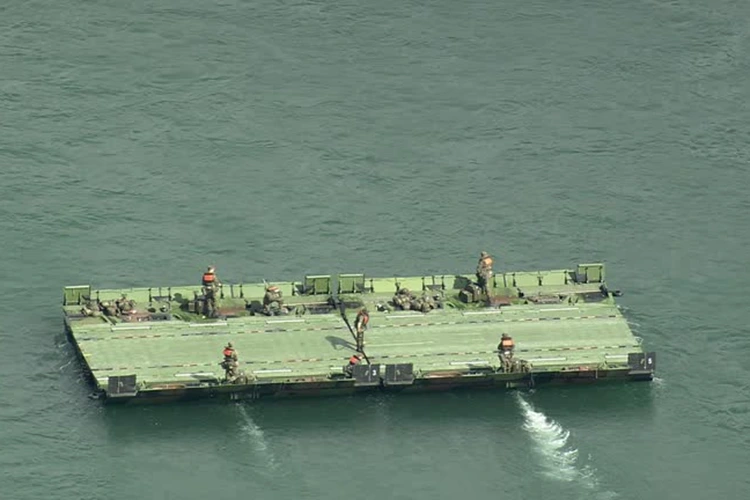
Table of Contents
- What Is a Rapidly Emplaced Bridge?
- Why Are Rapidly Deployable Bridges Needed?
- How Does the Bridge System Work?
- What Are the Key Performance Advantages?
- How Can Bridge Configurations Be Selected?
- Where Can Rapidly Deployable Bridge Systems Be Used?
- How Are Strength and Reliability Verified?
- How Should Buyers Choose a Reliable Supplier?
- Frequently Asked Questions
- Contact HAIDING SHIPYARD
What Is a Rapidly Emplaced Bridge?
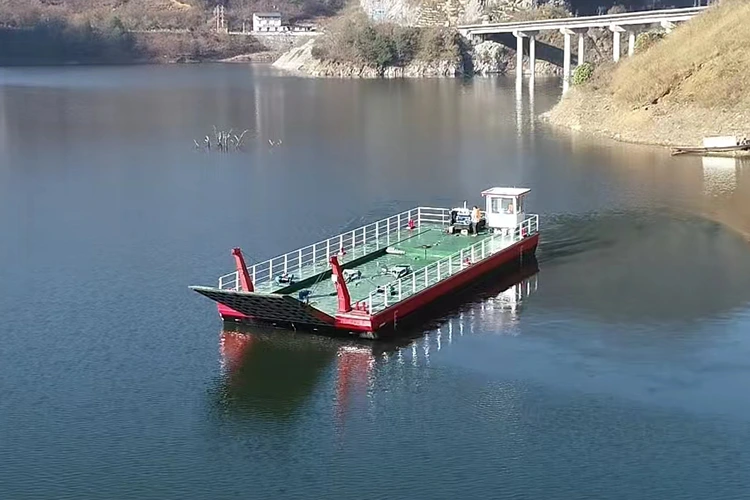
A Rapidly Emplaced Bridge is a modular water-crossing system designed to establish temporary transportation access in situations where permanent bridges or conventional construction methods cannot respond quickly enough. Instead of relying on a single fixed structure, the system uses standardized powered modules that can be transported, positioned, connected, and operated according to the requirements of a specific crossing.
A typical system is based on standardized 10-meter self-propelled pontoon modules. Multiple modules can be connected to form longer floating bridge structures, while individual powered modules can also function independently as ferry platforms.
This approach provides an important combination of mobility, modularity, load capacity, and deployment speed. It is particularly valuable when water-crossing infrastructure must be restored under time-sensitive conditions.
- Standardized modular pontoon construction
- Independent propulsion and navigation
- Integrated module connection systems
- Flexible bridge lengths
- Heavy-load transportation capability
- Floating bridge and powered ferry operation modes
Why Are Rapidly Deployable Bridges Needed?
Transportation infrastructure can become unavailable within minutes after flooding, extreme weather, bridge collapse, road damage, or other emergencies. Although permanent reconstruction is necessary for long-term recovery, emergency teams often cannot wait weeks or months for conventional construction to restore access.
A modular floating crossing provides an intermediate solution. It can establish a temporary transportation route while permanent infrastructure is being repaired or rebuilt.
For emergency agencies and engineering contractors, the main benefits include:
- Faster response: Modular equipment can be deployed considerably faster than conventional bridge construction.
- Flexible deployment: The number of connected modules can be adjusted according to waterway width.
- Reduced dependence on external equipment: Self-propelled modules can navigate and position themselves without relying entirely on tugboats.
- Multi-purpose operation: Individual modules can continue operating as powered ferry platforms.
- Temporary infrastructure recovery: Emergency transportation routes can be restored while permanent repairs continue.
How Does the Bridge System Work?
The operating principle combines independent powered modules with an integrated connection system. Each module can navigate toward the designated deployment area, after which the units are aligned and locked together to form a continuous floating structure.
1. Module Transportation and Positioning
Standardized modules simplify logistics and allow equipment to be prepared for different emergency scenarios. Each powered unit can independently navigate toward the required crossing location.
2. Automatic Alignment and Connection
After positioning, the modules are aligned and secured through the integrated connection mechanism. Intelligent control functions can assist with positioning, hydraulic balance, water-level compensation, and operational monitoring.
3. Bridge Formation
Once connected, multiple modules form a continuous floating bridge suitable for vehicles, personnel, equipment, and emergency logistics.
4. Independent Ferry Operation
When a full bridge is unnecessary, individual powered modules can operate as ferry platforms. This dual-purpose capability can improve equipment utilization across different stages of an emergency response or engineering project.
What Are the Key Performance Advantages?
The value of a rapidly deployable bridge is not determined by deployment speed alone. Structural stability, load capacity, positioning accuracy, environmental adaptability, and repeated-use durability are equally important when equipment is intended for demanding emergency applications.
| Performance Factor | Reference Capability | Operational Benefit |
|---|---|---|
| Module Length | 10 m standardized module | Flexible system configuration |
| Bridge Length | 10 m to 100 m+ | Adaptable to different waterways |
| 60 m Configuration Load | 60 tons | Supports heavy rescue and engineering vehicles |
| 60 m Deployment Time | Approximately 10–15 minutes | Rapid emergency access restoration |
| Full-Load Deck Deformation | Within 12 mm | Improved structural stability |
| Positioning Accuracy | Within 5 cm | More efficient module alignment |
| Operating Temperature | -30°C to +55°C | Suitable for varied climates |
| Anti-Overturning Safety Factor | ≥1.6 | Additional stability under demanding conditions |
These specifications demonstrate why modular bridge technology can be particularly useful for emergency infrastructure. The system is not simply a temporary platform; it combines structural engineering with propulsion, positioning, connection, and control technologies.
How Can Bridge Configurations Be Selected?
One of the major advantages of modular bridge engineering is the ability to select the number of modules according to actual site requirements. The appropriate configuration should consider waterway width, expected vehicle loads, environmental conditions, transportation requirements, and deployment objectives.
| Modules | Bridge Length | Rated Load | Typical Deployment Time | Typical Application |
|---|---|---|---|---|
| 1 | 10 m | 10 tons | 3–5 min | Small rivers and drainage channels |
| 2 | 20 m | 20 tons | 5–8 min | Urban flood response |
| 3 | 30 m | 30 tons | 7–10 min | Medium river crossings |
| 4 | 40 m | 40 tons | 9–12 min | Emergency vehicle access |
| 5 | 50 m | 50 tons | 10–14 min | Reservoir and engineering projects |
| 6 | 60 m | 60 tons | 10–15 min | Heavy-duty emergency operations |
| 8 | 80 m | 60 tons | 12–18 min | Wide rivers and large water areas |
| 10 | 100 m+ | 60 tons | 15–20 min | Large-scale emergency infrastructure |
For procurement teams, this modular structure also offers a degree of future scalability. Additional modules can be introduced as project requirements change instead of replacing the entire system.
Where Can Rapidly Deployable Bridge Systems Be Used?
Flood Control and Disaster Relief
Flooding can isolate communities by damaging roads and submerging conventional bridges. A temporary floating crossing can provide access for rescue teams, emergency vehicles, medical supplies, relief materials, and engineering equipment.
Emergency Water Rescue
During rescue missions, personnel and equipment may need to cross rivers, reservoirs, or flooded areas. Independent propulsion allows powered modules to reach operational locations without relying entirely on fixed transportation infrastructure.
Infrastructure Recovery
Following bridge collapse or road damage, temporary access can support construction vehicles, repair equipment, materials, and workers while permanent infrastructure is reconstructed.
Marine and Water Engineering
Port construction, reservoir projects, water conservancy work, offshore engineering, and pipeline-related infrastructure may require temporary transportation routes that can be relocated as project conditions change.
Emergency Logistics and Civil Defense
Rapidly deployable floating systems can also support emergency logistics, strategic transportation, large-scale rescue operations, and other situations requiring fast water-crossing capability.
How Are Strength and Reliability Verified?
Emergency bridge equipment must maintain predictable performance after deployment. For this reason, structural testing and repeated operational testing are essential parts of evaluating a modular system.
A standard 60-meter configuration has been tested at a rated load of 60 tons. During full-load testing, maximum vertical deck deformation remained within 12 mm, with no permanent deformation after unloading. The modular locking system also underwent repeated connection testing without loosening or structural damage.
Additional evaluations included:
- 72-hour continuous full-load operation testing
- More than 1,000 assembly and dismantling cycles
- High-temperature and low-temperature testing
- Rain and wind-wave environmental testing
- Propulsion system testing
- Hydraulic system testing
- Electronic control testing
- Navigation and positioning verification
The intelligent control platform can monitor bridge attitude, provide hydraulic balance adjustment, compensate for water-level changes, protect against overload, and assist with fault diagnosis. Positioning tests achieved alignment accuracy within 5 cm.
How Should Buyers Choose a Reliable Supplier?
Purchasing an emergency bridge should involve more than comparing a single load rating or bridge length. Buyers should evaluate the complete engineering solution, including structural manufacturing, propulsion, control systems, deployment procedures, quality inspection, customization, and after-sales support.
When comparing a China manufacturer or international supplier, consider the following factors:
- Modular engineering capability: Can the supplier provide different bridge lengths and configurations?
- Load performance: Has the structure undergone realistic load testing?
- Deployment efficiency: Can the system be positioned and assembled quickly under suitable site conditions?
- Navigation capability: Are powered modules capable of independent movement?
- Environmental adaptability: Is the system designed for the actual water and climate conditions?
- Quality control: Does production include material, welding, hydraulic, electrical, navigation, and final operation inspections?
- Customization: Can the supplier adapt bridge length, load requirements, controls, and supporting equipment?
- Technical support: Are commissioning, operation guidance, spare parts, and maintenance services available?
For buyers evaluating modular pontoons, emergency water-crossing equipment, or related emergency rescue equipment, selecting a manufacturer with integrated engineering and production capabilities can simplify project coordination.
Frequently Asked Questions
Can the bridge operate without tugboats?
Yes. Each powered module is designed with an independent propulsion system, allowing it to navigate and position itself without depending entirely on external towing equipment.
How quickly can a 60-meter bridge be deployed?
Under suitable operating conditions, a standard 60-meter configuration can typically be deployed within approximately 10–15 minutes. Actual deployment time depends on water conditions, site preparation, personnel, and operating procedures.
What is the maximum bridge length?
The modular configuration can be expanded beyond 100 meters by connecting additional powered modules. The final configuration should be selected according to waterway width, load requirements, and operating conditions.
How much weight can the bridge support?
A standard 60-meter configuration has a rated load capacity of 60 tons. Different configurations can be selected according to project requirements.
Can individual modules be used as ferries?
Yes. Individual powered modules can operate independently as ferry platforms for personnel, vehicles, rescue equipment, and emergency supplies when a complete bridge is not required.
Where can this type of bridge be operated?
The system is designed for applications involving rivers, lakes, reservoirs, flood channels, and coastal shallow waters, subject to project-specific operating conditions and engineering assessment.
What temperature range can the system support?
The stated operating temperature range is approximately -30°C to +55°C. Final environmental suitability should be confirmed according to the specific project conditions.
Can the bridge be customized?
Yes. HAIDING SHIPYARD can provide customized configurations covering bridge length, load requirements, control systems, and supporting equipment according to project requirements.
Does the manufacturer provide technical support?
Technical consultation, configuration guidance, operation support, spare parts assistance, and maintenance support can be provided for applicable projects.
Contact HAIDING SHIPYARD
When floods, damaged bridges, or remote engineering conditions interrupt normal transportation, a rapidly deployable water-crossing system can help restore access while permanent infrastructure work continues. HAIDING SHIPYARD combines modular bridge manufacturing, self-propelled pontoon technology, structural engineering, and customized configuration services to support demanding emergency and marine applications.
If you are planning a flood-control project, emergency transportation system, infrastructure recovery program, or marine engineering application, contact us to discuss your required bridge length, load capacity, waterway conditions, deployment objectives, and customization needs. HAIDING SHIPYARD can provide configuration recommendations and technical solutions tailored to your project.